
Among the Leaves with Alexandra
- Woman Up Cleveland
- Aug 1, 2025
- 11 min read

Updated: Nov 1, 2025
Alexandra Faidiga - Assistant Curator at Holden Forests & Gardens

Cleveland has no shortage of indoor and outdoor oases to help the community appreciate its natural beauty. From the Metroparks system to the Cultural Gardens and everything in between, our city has so much to offer when it comes to showing off our scenic side. High on the local list of places to show off to tourists and native Clevelanders alike is the Holden Arboretum & the Cleveland Botanical Garden.
Holden Forests and Gardens, the non-profit organization that oversees these natural campuses, was originally founded in 1930 and became a joint venture between the Arboretum and the Botanical Garden in 2014. Their mission to “connect people with the wonder, beauty, and value of trees and plants, to inspire action for healthy communities” is admirable for so many reasons and truly allows for the people in our city to learn more about and enjoy plant life they would normally have to travel far and wide to see for themselves.
With 3,600 acres of green space at the Arboretum, the 18,000 square foot Eleanor Armstrong Smith Glasshouse at the Botanical Garden, and so many more moving parts to the organization, including a third campus solely used for rhododendron breeding and research, there is lots to oversee for the Holden Forests and Gardens team. This is where the skilled and knowledgeable staff comes in.
Alexandra Faidiga, Assistant Curator for Holden Forests and Gardens, has been on this team for 3 years and is an integral part of what makes these non-profit green spaces a massive success for Clevelanders and visitors alike. Her work documenting plant life, acquiring new plants for the living collections, and working closely with horticulturists is what helps the organization to curate what is essentially a living museum.
Alex’s work is a primary example of all the efforts that often go on behind the scenes in public spaces that ensure the community can enjoy them to the fullest. Keeping track of plant life and documenting what exists on the grounds helps other teams at the Arboretum and Gardens to do their jobs as well. Like a well-oiled machine, every aspect of this work has to connect in order to create the guest experience they seek to provide all patrons.
Once we spoke with Alex, it came as no surprise to hear that plants have always been “her thing”. It is clear to see the passion and interest she has in all aspects of her work, and naturally, we wanted to hear more about her journey to get there. After getting her undergraduate degree from Case Western Reserve University here in Cleveland, she continued her education, ultimately receiving her masters in Plant Ecology and Evolution from University of Tennessee Knoxville.

Although the biology department at Case proved to be very engineering and premed focused, she gained essential experiences working on plant ecology research projects in Jeanene Burns’ Lab during her time there that really showed her what her education could become.
She told us, “I worked with herbarium specimens for one of my projects in graduate school which was really fun and got me interested in plant collections. They are different from a living plant collection because they are a collection of dried pressed plants. And in college, I was a work-study student at the Natural History Museum in the Paleobotany Department which I loved. I liked thinking about why we have what we have in our collections and it was my introduction to a museum setting.”
After moving back to Cleveland with her husband, Alex began working as a Plant Recorder for Holden Forests and Gardens in 2022, primarily focused on data collection and taking inventory of the plant collections. Although she still has some of these tasks as a part of her everyday duties, her role has expanded to include more of the curation side of things. She explained her role as Assistant Curator best, saying, “Coordinating plant collecting trips, thinking about our collections policies, working with our horticulture team on plant choice and things like that. But one of the biggest parts of my job is documenting all of the plants on our campuses, keeping track of them, and being a point of contact when anyone has questions about our collections.”
Through her time exploring different avenues and eventually landing on curation over academia, Alex discovered a love for collections and ultimately a love for her work at Holden. We asked her to tell us more about what is special when it comes to the Holden Arboretum and Cleveland Botanical Gardens compared to other places or even other career paths she has explored. Alex told us, “It is very much a learning culture. Everyone is learning all of the time, about their own jobs, how to work together better, and learning how we can be better as an institution.”
Alex credits her continued education with leading her to be better at her job. The depth of her work reaches far beyond the beauty and calmness of nature and the gardens. Every day, she finds herself in a place that offers access and enjoyment of plants that you don’t get the chance to see anywhere else. “Being a plant nerd,” she says, "It's the perfect place to work.”
As for what makes Cleveland’s gardens so special compared to others, it all comes down to the structure of the non-profit itself. Although many gardens around the country and world are non-profit organizations, some are for profit, and others fall under the supervision of their respective city governments as well. Alex tells us, “To have two campuses that are open to the public is really unique and can also be really challenging. We also have the Leach Research Station in Madison which is a rhododendron breeding and research station. They’re all very different campuses.”
She continued on to say that the Arboretum’s collections boast a diverse array of woody plants
from around the world as well as Ohio native wildflowers, many of which were collected directly
from the wild over the past seven decades. The Botanical Garden, being an urban garden, boasts outdoor spaces to inspire home gardeners contrasted with plants from Madagascar and Costa Rica that thrive in the glasshouse. With every Botanical Garden around the world being somewhat different, there are lots of little features that make them so special.
“It’s a really cool opportunity for people who live in Cleveland or people who live in between the two campuses. Being able to go to both as a member is a really cool experience,” Alex said. “A lot of people don’t even know that it's the same institution. A lot of people still think we are separate, but now it's all under one umbrella.”
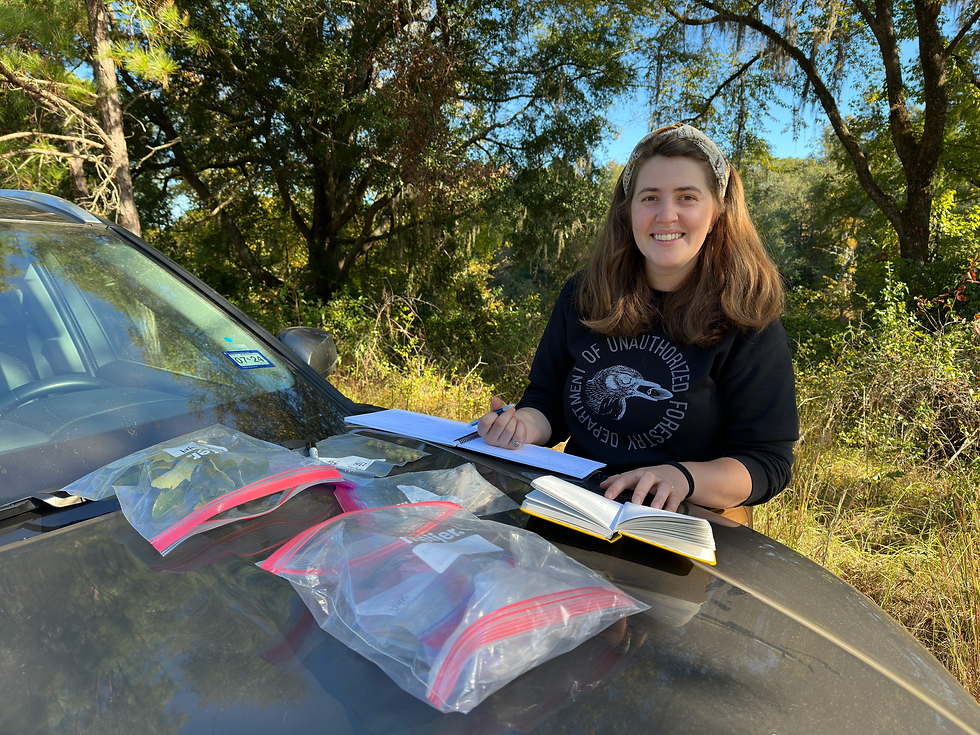
Collaboration is a massive part of not only Alex’s role, but of the organization as a whole. Many of her favorite projects and experiences that have come along with her job, have been due to the importance of collaboration within Holden and throughout the botanical garden community. Since non-profit resources can be hard to come by, there is a need for mutually beneficial trades and conversations in order to continue expansion for all groups, all around the country.
Alex told us a bit about how valuable collaboration can be saying, “Every single garden and arboretum is different, I think that's one of the reasons that I find a lot of value in going to conferences to see how different botanical gardens operate and how they’re structured.”
As part of the ever-evolving educational aspect of her job, she often finds herself working with others to benefit all involved. For example, she told us a lot about her work with the Dusty Goldenrod Preserve in Highland Heights, Ohio. A very small patch of meadow tucked into the city park smack in the middle of a suburban neighborhood boasts the only place in the state of Ohio that Solidago puberula, the dusty goldenrod, exists.
Partnering with the preserve to collect seeds has been a highlight of her career so far. For the past several years, Holden’s nursery team has grown dusty goldenrod from seed collected in the preserve. Some plants grown from these seeds have been planted out in the collections, and some have been planted back into the preserve. Alex told us, “It is a really cool showcase of how we can use and display rare and interesting plants in our gardens. People may not have ever known that this is a rare and special plant in Ohio. It's a cool intersection of plant conservation, horticulture, and education that I think is an amazing thing to have on display here at the Botanical Garden.”
Another incredible project Alex shared with us was her work collaborating with botanist Ron Lance and staff at Polly Hill Arboretum on the rare oak species Quercus austrina, or bluff oak, in
2023. Using a grant that they received, the Holden team was able to travel through Florida, Georgia, Alabama and Mississippi to collect acorns for conservation within their living collection. After bringing the acorns back to Holden, the team has grown seedlings that will eventually be distributed to other gardens as well, further proof of the shared teamwork that goes into the success of these institutions. “It allows us to collaborate with people at other botanical gardens to work together in conserving species. A lot of people think botanic gardens are just beautiful places to go but they have so much opportunity for conserving species too.”

Alex often sees this as the most meaningful part of her work. Being able to contribute to the conservation of the collections she cares so much for drives her to not only continue learning, but to continue collaborating for the mutual benefit of many gardens. She said, “We call it ex-situ conservation because these plants are growing outside of their natural habitat in our collections. That's the most important part of my job to me and I hope to do more in the future.”
We went on to ask Alex about the more challenging parts of her journey, specifically in a science based field or as a woman. Unsurprisingly, she shared that many of the people who she found herself surrounded by in school and now in her career in public gardens have been women. However, she continued to tell us that for her own circles and in her own family, she has been one of the first to pursue a career that not only required an advanced education, but that has a very niche area of study and work opportunity.
This gave her a small sense of misunderstanding that led to some questioning if this was the correct path for her throughout her time studying. She told us, “I had the experience of feeling like I didn’t really know what I was doing and there were these unwritten rules for how you decide where to go. Who you talk to and what you’re supposed to do. It’s just something I had to kind of learn on my own.”
Without a blueprint, career development and the ‘right way’ to do things wasn’t always clear. But Alex persevered to follow her dreams and figured out her own answers, in the way that fit where she wanted to end up. This explains even further how her dedication sets her apart and makes her a perfect fit for a role that requires so much insight and understanding.
Since it can be difficult to describe the importance of her work to anyone with little understanding of the botanic worlds and the public garden industry, we asked Alex to simplify for us what she wants others to know about not only our beloved Cleveland institutions, but about botanical gardens and public green spaces everywhere.
“Understanding that a botanical garden or arboretum is a living museum of plants, and is different from a garden that is purely for aesthetic display in that we keep records on all the plants in our collections. That is part of what makes a botanic garden a botanic garden. Keeping records and developing collection policies and collection goals that guide what we do,” she told us.
Her passion for sharing why plants are acquired and displayed is evident and she has such a deep understanding of the value of conservation. The role that gardens and arboretums play in the protection and education of plant life, both native and exotic, is what really sets living museums apart from other collections of history and art.
Especially today, Alex is dedicated to preserving not only the knowledge of, but the physical specimens of plants from around the world. She said, “When you buy a plant from a nursery, you really don't know most of the time where it's coming from. Collecting seed directly from the
wild is important because we know exactly where it comes from and how much genetic diversity
we are capturing within a population. As the climate warms and as habitats are decreasing in abundance, genetic diversity is super important to species resilience.”
With this explanation, it is obvious that Alex’s role goes deeper than just beauty and public enjoyment. Her efforts to ensure the resilience of plants in our community and beyond, is truly something that makes our entire world better and reaches far beyond our city. She gave so much credit as well to all the work that goes into horticultural science behind the scenes saying, “My background is in ecology research so I was more into the botany side of things versus the science of how you care for plants. But it is super interesting and very complex. It is more than just watering a plant or pruning it back. Our horticulturists are really talented people and we wouldn’t be able to do what we do without them.”
It all comes back to the ability for Alex and her fellow teammates to receive the resources necessary to continue their work, and branch out further into collaborations and research. Being awarded grants is a huge part of what allows curators and horticulturists to continue their important roles and participate in collecting trips that help bring more plant life to our institutions.
Splitting resources and sharing time on trips and missions helps ease the load on our local organization as well as those they collaborate with. It is not uncommon for groups like this to be a non-profit but with that comes the extra struggles of maintaining support in order to continue participating in and completing this important work. Like all non-profits, the work is essential and could always benefit from more and more support.
Alex is not only an integral part of this current process and the organization’s involvement in continued curation and developing collections, she also has big dreams for where the institution can go. We asked her where she saw things heading in the future for her and her role and she told us all about her efforts to continue serving the community by continuing her important collecting, exchanging, and curating.
She also mentioned the recent completion of an important and exciting project for Holden that includes an online map of Holden’s plant collections called Flora Finder. The web application can help users navigate a map of what the gardens have to offer. It creates a much more user-friendly experience than the previous, outdated mapping system the organization had been using and expands the connections between the patrons and institution they support.
“Before we had Flora Finder, the people who knew how to use our database were the only ones who could pull data from it. This project was funded by IMLS, the Institute of Museum and Library Services, and it updates and modernizes our systems that we use for tracking plants and collections. And the biggest part of that is the integration of our database with geographic information systems that helps us map things as well,” Alex shared.
Now users can go on the Holden website and explore a map, clicking to learn more about specific plant life and where it can be found. This project is not only huge for the public, but it also benefits the staff at Holden and allows them to easily navigate collections and find the plant information they seek in a much more efficient way.
In the coming years, Alex hopes to continue her current work developing Flora Finder, curating collections for the Arboretum and Botanical Gardens, and collaborating with other botanical institutions. She also aims to grow in her role and in the organization by seeking further funding for collection trips, expanding the curation team, and helping others see the value in the importance of plant conservation.
Clearly, Alexandra Faidiga knows what it takes to not only curate curiosity, but to inspire those around her and those viewing her work to ask questions, be present, and learn something new. Being mindful of the importance of education, conservation, and enjoyment are what makes her such a successful curator for Holden Forests and Gardens. She is so obviously dedicated and loudly passionate about her interests that it makes you want to hear more and more about her knowledge of plant life and its essential functions in our world. She is a perfect example of what it means to do a job that requires mindfulness and depth. It is an honor to hear her share her love for her work and we wish her all the best in her continued efforts to truly make our world a better place to be.


Comments